

Why Football Odds Move Before Kick-off
Football odds rarely remain unchanged from the moment they are released until kick-off. A team may open at -0.5 on the Asian handicap and later move to -0.75. The price on Over 2.5 goals may fall from 1.95 to 1.80, while the favourite also shortens in the 1X2 market.
These changes suggest that expectations surrounding the match have been updated. New team information may have emerged, the expected starting line-up may have changed, or several major odds providers may have adjusted their assessment.
An odds movement should not be treated as a guarantee of the final result. It is better viewed as a response to the information available at a particular time. Understanding what changed and why is more useful than simply following the side with the shorter price.
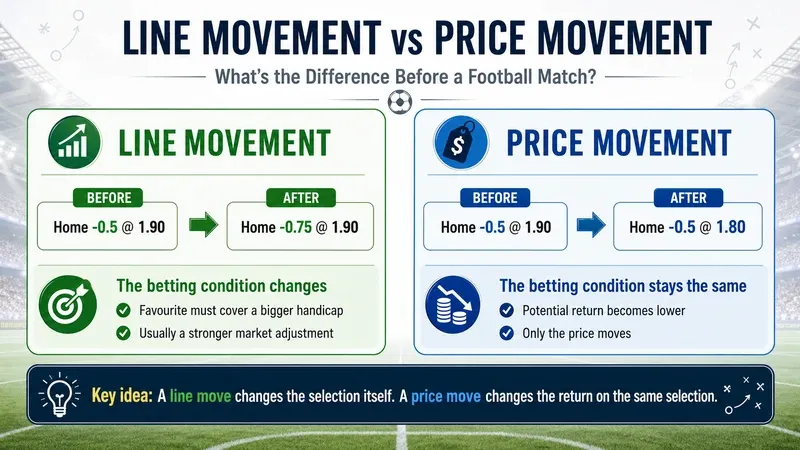
Line movement and price movement are not the same
A football market usually contains both a betting line and a price.
Consider a home team listed at -0.5 with Decimal odds of 1.90:
- The -0.5 is the Asian handicap line.
- The 1.90 is the price attached to that line.
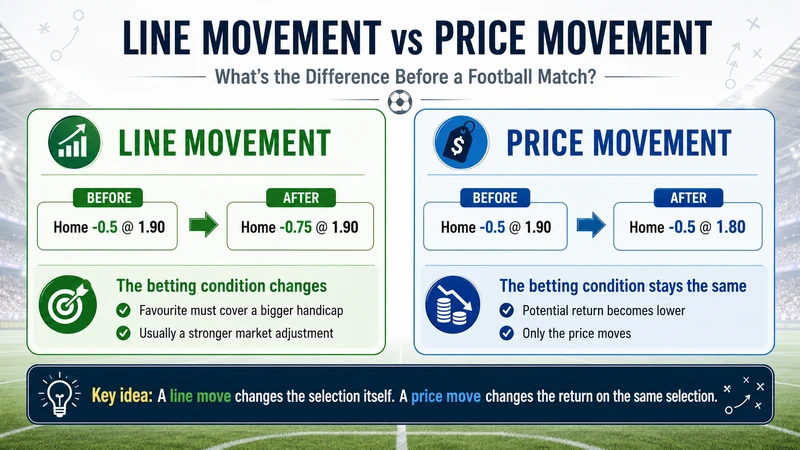
If the handicap moves from -0.5 to -0.75, the conditions of the selection have changed. The home team is now required to overcome a more difficult handicap.
If the handicap remains at -0.5 but the price falls from 1.90 to 1.80, only the potential return has changed. The selection still requires the home team to win the match.
A move in the line is often more significant than a small price adjustment, although both can provide useful information. The same distinction applies to over/under markets. Over 2.5 shortening from 1.95 to 1.80 is different from the main total moving from 2.5 to 2.75.
Compare the same fixture, market and line
Odds can only be compared properly when all conditions are identical. Home -0.5 at one source should not be compared directly with Home -0.75 at another because the settlement rules are different.
A useful record should include:
- The opening line and price.
- The current line and price.
- The time each figure was checked.
- Whether the team line-up had been confirmed.
- Whether the movement appeared across several sources.
Readers tracking upcoming matches can use football odds data from Keonhacai5 to compare Asian handicap, over/under and 1X2 information across the main pre-match markets.
Recording the time is important. A movement that occurs immediately after a team announcement may be easier to explain than a gradual adjustment that develops over several days.
Team news, injuries and suspensions
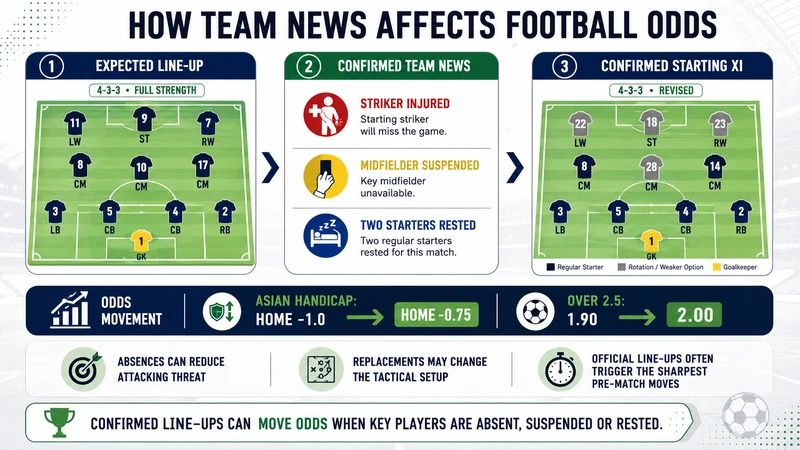
Confirmed team news is one of the main reasons football odds move before kick-off. Early prices are often based on an expected line-up, but that expectation can change when injuries, suspensions or late fitness concerns become known.
The absence of a regular starter does not always have the same effect. Several factors should be considered:
- The role of the missing player.
- The quality of the replacement.
- Whether the team must change formation.
- Whether several players are missing from the same area.
- Whether the information was already public when the opening line was released.
A team missing its main striker may create fewer clear chances, but the impact depends on the alternative options. A regular substitute who understands the system may reduce the effect. An inexperienced replacement could force the team to attack in a different way.
Defensive absences can be just as important. Missing two centre-backs may leave a team with an unfamiliar pairing, while the absence of a holding midfielder can expose the space in front of the defence.
Suspensions are usually known earlier than late injuries. This means the opening line may already reflect them. When a price moves later, it is important not to assume that an old piece of information caused the change.
Rotation and the confirmed starting eleven
Squad rotation can create a large difference between a team’s general strength and the side that actually starts the match.
Clubs involved in several competitions may rest important players before a cup final, a European match or a decisive league fixture. A favourite may initially appear strong based on its usual first eleven but become less convincing once several starters are left out.
The opposite can also occur. A manager expected to rotate may select a stronger team than predicted, causing the price to move back towards that side.
Confirmed line-ups are therefore more useful than rumours. A potential absence can influence early discussion, but the official team sheet provides clearer evidence about the players available and the shape the manager may use.
Tactical changes can affect handicaps and totals
Football odds can also move because of tactical expectations rather than individual absences.
A manager may switch to a more defensive midfield, add another centre-back or choose two forwards instead of one. These decisions can change both the expected balance between the teams and the likely number of goals.
For example, a team using a deeper defensive block may become harder to beat while offering less attacking threat. This could affect the Asian handicap and place downward pressure on the expected goal total.
A high defensive line may create the opposite effect. It can help a team control possession, but it may also leave space for fast counter-attacks.
The effect of a tactical change depends on the opponent. A possession-based team may struggle against organised pressing, while a side that defends deep may be comfortable allowing an opponent to circulate the ball in less dangerous areas.
For that reason, handicap and total movements should be considered together. A favourite becoming stronger in the handicap while the total moves down may suggest expectations of a controlled match rather than an open one.
Scheduling, fatigue and match priorities
The number of days between matches can influence both team selection and physical performance.
A team that played 120 minutes in a cup tie only a few days earlier may have less energy, especially if the squad lacks depth. Long-distance travel and repeated away fixtures can also reduce recovery time.
Match priorities matter as well. A club positioned safely in mid-table may approach a late-season fixture differently from a team fighting for survival. In a two-legged tie, a side protecting an advantage may value control over attacking risk.
However, the phrase “must win” should be treated carefully. Needing a result does not automatically improve performance. It may increase intensity, but it can also create pressure or encourage a team to take greater defensive risks.
The most useful question is how the situation is likely to influence selection, tempo and tactical behaviour.
Weather and pitch conditions
Weather usually matters most when conditions are severe enough to change how the match is played.
Heavy rain can slow the surface and reduce passing quality. Strong wind may affect long balls, crosses and set pieces. Extreme heat can lower the tempo and make physical fatigue more important later in the match.
A poor pitch may also reduce the advantage of the technically stronger side. Teams that rely on quick passing can find it harder to control the game when the surface is uneven or waterlogged.
Normal weather should not be overanalysed. The effect becomes more relevant when conditions are unusual, severe or clearly capable of changing the expected style of play.
Wider adjustments across the market
Not every odds movement follows one obvious public announcement. Sometimes several major sources adjust their lines in the same direction without a single clear headline.
This may happen because of:
- Updated statistical models.
- A revised assessment of team strength.
- Corrections to an early opening line.
- New information available to professional analysts.
- Broader movement across leading odds providers.
Opening prices are estimates based on the information available at that stage. They are not necessarily final or perfect. As more data becomes available, those estimates may be adjusted.
A movement appearing across several sources is generally more informative than an isolated change on one platform. Even then, the latest price remains an assessment rather than proof that the result will follow the same direction.
A more detailed guide to football odds movements explains how changes in the main line differ from smaller price adjustments on the same market.
How to interpret an odds movement
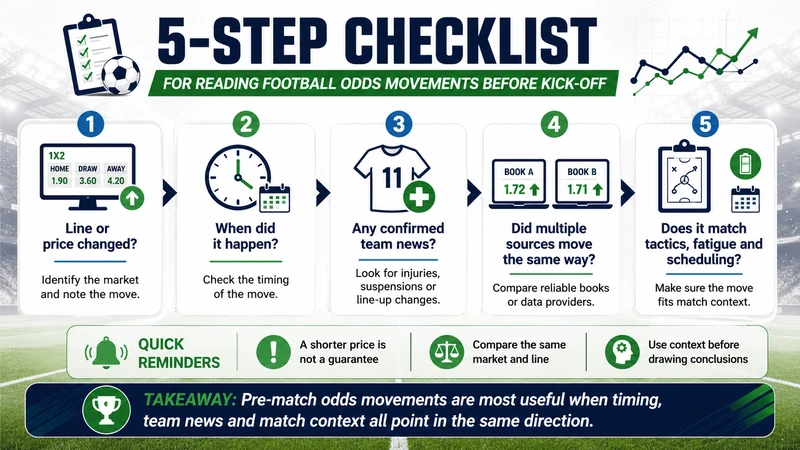
Before drawing a conclusion, consider five questions:
- Did the betting line change, or only the price?
- When did the movement occur?
- Was any confirmed team news released at that time?
- Did several sources move in the same direction?
- Does the change fit the tactical, physical and scheduling context?
This process helps separate meaningful information from ordinary price fluctuation.
A move from -0.5 to -0.75 may suggest a stronger assessment of the favourite, but it still does not guarantee a comfortable victory. The current price on both sides must also be considered.
Similarly, a falling Over 2.5 price is not the same as the total moving to 2.75. One changes the return; the other changes the conditions of the selection.
Common mistakes when following odds
One common mistake is assuming that every shorter price points to the eventual winner. Odds summarise expectations, but football results remain uncertain.
Another is reacting to information that has already been reflected in the line. An injury announced several days earlier may have influenced the opening price, leaving little reason to connect it with a later movement.
Different odds formats can also create confusion. Decimal 1.90 and Hong Kong 0.90 represent the same underlying price. Changing the display is not a genuine odds movement.
Finally, prices on different handicaps should not be compared as though they carry the same conditions. Home -0.5 at 1.80 and Home -0.75 at 2.05 may refer to the same team, but they are not identical selections.
Conclusion
Football odds move as expectations around a match change. Confirmed line-ups, injuries, rotation, tactics, scheduling, weather and wider adjustments can all influence Asian handicap, over/under and 1X2 prices.
The key is to separate a movement in the betting line from a movement in price, then check whether the timing and available information explain the change. Odds provide a useful summary of current expectations, but they should never be treated as certainty or as a reliable source of income.