

La Liga attracts football supporters from around the world thanks to its technical quality, historic clubs, emerging talents, and varied tactical styles. While major teams often receive most of the attention, understanding an individual fixture requires much more than comparing club reputations.
Recent form, home and away performance, injuries, suspensions, fixture congestion, and tactical matchups can all influence what happens on the pitch. Pre-match odds add another layer of information, but they should be interpreted as expectations rather than guarantees.
A structured approach helps supporters understand why certain numbers appear and whether the available evidence supports those expectations.
Understanding La Liga Odds on BongdaNET

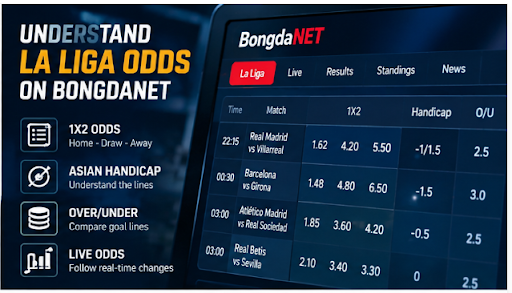
When examining La Liga odds on BongdaNET, readers may encounter several common types of football markets.
European 1X2 odds represent three outcomes: home win, draw, or away win.
Asian handicap data introduces a handicap intended to reflect the perceived difference between the teams.
Totals focus on the expected number of goals.
These figures can change before kickoff.
New information about injuries, lineups, or scheduling may alter expectations. For this reason, supporters should note when the odds were recorded rather than assuming a number published earlier in the week remains unchanged.
Recent Form Should Be Examined Carefully
The last five or six matches provide a useful snapshot, but results need context.
A team may have won four consecutive matches against opponents near the bottom of the table.
Another might have a weaker record after facing several title contenders.
Looking only at wins and losses can therefore create a misleading comparison.
Supporters should examine goals scored, goals conceded, chance creation, and the strength of opposition.
A narrow victory achieved with very few chances can tell a different story from a dominant performance with sustained attacking pressure.
Using BongdaNET as a Data Reference

When consulting BongdaNET, readers can combine available information with other football data rather than relying on a single statistic.
League position provides the long-term picture.
Recent results describe current form.
Home and away records reveal whether performance changes significantly depending on venue.
Team news then helps determine whether the players responsible for previous results are likely to participate in the upcoming fixture.
The strongest analysis comes from connecting these categories rather than treating them independently.
Home and Away Performance
Venue can have a significant influence in La Liga.
Some clubs collect a large proportion of their points at home, where familiar surroundings and crowd support contribute to confidence.
Other teams may perform particularly well away because their tactical system suits counterattacking situations.
For an upcoming fixture, comparing the home record of the host with the away record of the visitor is often more relevant than using overall standings alone.
Travel and recovery time may also matter when schedules become congested.
Tactical Matchups
League position cannot fully describe how two styles interact.
A possession-oriented team may struggle against a compact defensive block.
A counterattacking side might create fewer attacks but produce more dangerous opportunities.
Pressing intensity, defensive line height, set pieces, and midfield structure can all influence the matchup.
Previous meetings may provide clues when managers and tactical systems remain similar.
However, results from several seasons ago should be treated cautiously because squads and coaching strategies can change significantly.
Injuries and Suspensions
Player availability can alter expectations.
Missing a leading striker can reduce finishing options, while the absence of a defensive midfielder may expose the back line.
A central defender's injury can affect buildup play as well as defensive organization.
The impact depends on squad depth.
Large clubs may have experienced replacements, while smaller teams can find it harder to compensate.
Confirmed lineups therefore become particularly valuable close to kickoff.
Fixture Congestion
Spanish clubs competing in European or domestic cup competitions often face demanding schedules.
A midweek match can leave only a few days of recovery before the next league fixture.
Managers may rotate players or reduce pressing intensity to manage fatigue.
The schedule after the match also matters.
If another important fixture is approaching, selection decisions may reflect broader priorities.
Scheduling does not guarantee a particular result, but it provides context that league tables alone cannot show.
Odds Are Not Predictions With Certainty
Even detailed analysis cannot remove football's unpredictability.
An early red card, penalty, injury, deflection, or individual mistake can completely change the match.
A team can dominate possession and still lose.
Another may create fewer chances but finish them more efficiently.
Odds therefore represent expectations and uncertainty rather than a promise about the final score.
If odds are used for wagering, participants should establish a fixed entertainment budget and avoid increasing stakes to recover losses.
A Practical Research Routine
A structured routine can begin with league position and recent form.
Next, separate home and away performance and examine opponent strength.
Then review injuries, suspensions, expected lineups, fixture congestion, and tactical characteristics.
Only after building this sporting context should odds be compared with the available evidence.
After full time, reviewing the result and match statistics can show which assumptions were supported and which were contradicted.
This creates a repeatable learning process rather than a focus on individual predictions.
Conclusion
La Liga provides a rich environment for football analysis because teams differ in resources, tactical identity, and venue performance.
Odds add another layer of information, but they become more useful when combined with recent form, injuries, scheduling, and tactical context.
No method can predict every match correctly.
The purpose of structured analysis is to understand why expectations exist and how much evidence supports them.
That approach allows supporters to follow Spanish football more thoughtfully while recognizing that uncertainty remains an essential part of every fixture.