

Card games have existed for generations, but online platforms have changed how people discover and learn them. Games that once required several players to gather around the same table can now be presented through browsers, mobile devices, and dedicated applications. Mậu Binh, commonly associated with Chinese Poker, is one example that continues to attract interest because it combines simple card rankings with a distinctive hand-arrangement system.
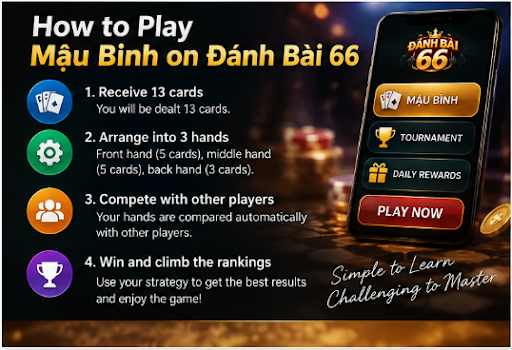
The basic concept is straightforward: players receive thirteen cards and divide them into three separate hands. The challenge comes from arranging those hands according to the correct strength order. Understanding the structure is essential because a powerful combination placed in the wrong position can create an invalid arrangement.
Exploring Online Card Games Through Đánh Bài 66
Users researching Đánh Bài 66 should first determine what type of platform they are visiting and whether the games are free-to-play or involve money or other items of value.
This distinction matters because real-money gambling may be regulated or prohibited depending on jurisdiction.
Players should independently check the legal requirements and minimum age that apply where they live before participating in any money-based activity.
Website security is also important.
A strong, unique password should be used for each account, and login credentials or verification codes should never be shared with another person.
The fact that a website is accessible through a browser does not automatically mean every service on it is lawful or appropriate in every location.
Understanding the Structure of Mậu Binh
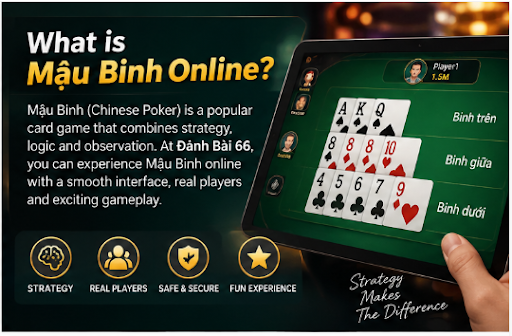
Mậu Binh generally uses thirteen cards that must be divided into three hands.
Two of the hands contain five cards each, while the remaining hand contains three.
The hands must follow a particular strength order. This means players cannot simply build one extremely strong group without considering the other two.
A valid arrangement requires balance.
This structural requirement creates much of the decision-making element in the game.
Players familiar with poker will recognize combinations such as pairs, two pairs, three of a kind, straights, flushes, full houses, and four of a kind in the five-card hands.
However, exact rules may vary depending on the version being played.
Learning Mậu Binh Online
A page covering Mậu Binh (Chinese Poker) online can help new players understand how the game is presented digitally.
The first priority should be learning the rules rather than focusing on speed or outcomes.
Online interfaces often show the three hand positions clearly and may provide visual assistance during arrangement.
However, players should still understand why a particular arrangement is valid.
The three-card hand has fewer possible combinations than the five-card hands, so its ranking structure may feel different.
Learning these distinctions through practice can reduce basic mistakes.
Whenever possible, beginners can use non-financial or practice modes before considering versions involving real money.
Understanding Basic Hand Rankings
Hand-ranking knowledge is essential.
A pair contains two cards of the same rank. Two pair contains two different matching pairs. Three of a kind contains three cards of equal rank.
A straight contains cards in sequential order, while a flush is formed from cards sharing the same suit according to the applicable rules.
A full house combines three of a kind with a pair, while four of a kind contains four cards sharing the same rank.
Recognizing these combinations quickly makes the arrangement process easier.
However, creating the strongest possible individual hand is not always the best decision because the remaining cards must still form valid groups.
Balance Between the Three Hands
One of the most interesting aspects of Mậu Binh is the need to distribute strength.
Suppose a player receives several strong cards. Putting all of them into one five-card hand may create an impressive combination, but it could leave the remaining groups extremely weak.
A better arrangement may spread value more effectively.
This does not guarantee success because players cannot control their opponents' cards.
The objective is to make the strongest valid arrangement possible using the available information.
That distinction is important: skill affects decision quality, but chance still determines the cards received.
Common Beginner Mistakes
A frequent mistake is rushing to arrange cards without considering the entire thirteen-card set.
Players may build one hand first and only afterward realize that the remaining cards cannot form a suitable structure.
Another error is misunderstanding the order requirement between hands.
Learning the interface and ranking system before playing under time pressure can reduce these problems.
Players should also avoid assuming that previous deals influence the next one.
A series of weak hands does not mean a strong hand is “due,” and a winning sequence does not guarantee continued success.
Each deal should be treated on its own terms.
Managing Financial Risk
If a version of Mậu Binh involves real money and participation is lawful where the user lives, financial limits should be established before play begins.
A fixed entertainment budget should be separate from money needed for rent, bills, food, savings, or other important expenses.
Players should not increase spending simply to recover previous losses.
This behavior increases the amount at risk without changing the randomness of future cards.
Tracking total spending over time can also provide a clearer picture than focusing on individual sessions.
Managing Time as Well as Money
Online access can make card games available continuously.
For that reason, time limits can be useful even when no money is involved.
Players can decide in advance how long a session will last or how many games they intend to play.
When the limit is reached, stopping helps preserve the activity as entertainment.
If gaming begins to interfere with sleep, work, study, or relationships, taking a break and seeking appropriate support can be beneficial.
Protecting the Account
Online card-game accounts may contain personal details, so basic security practices matter.
Users should verify the website address before entering login information and avoid suspicious links received through unsolicited messages.
Public computers and unsecured networks should be treated cautiously.
Transaction histories should also be reviewed periodically if financial activity is involved.
No legitimate support process should require a user to reveal a password.
Conclusion
Mậu Binh is an interesting card game because it combines familiar poker-style rankings with the challenge of arranging thirteen cards across three separate hands. Beginners benefit most from learning the ranking system, hand-order requirements, and the relationship between the three groups before focusing on speed.
Online versions make the game easier to access, but they also introduce considerations involving account security, local regulations, spending, and time management.
No arrangement strategy can guarantee favorable cards or consistent wins. The most realistic approach is to treat the game as entertainment, understand the role of chance, and maintain clear limits whenever money or extended playing time is involved.