

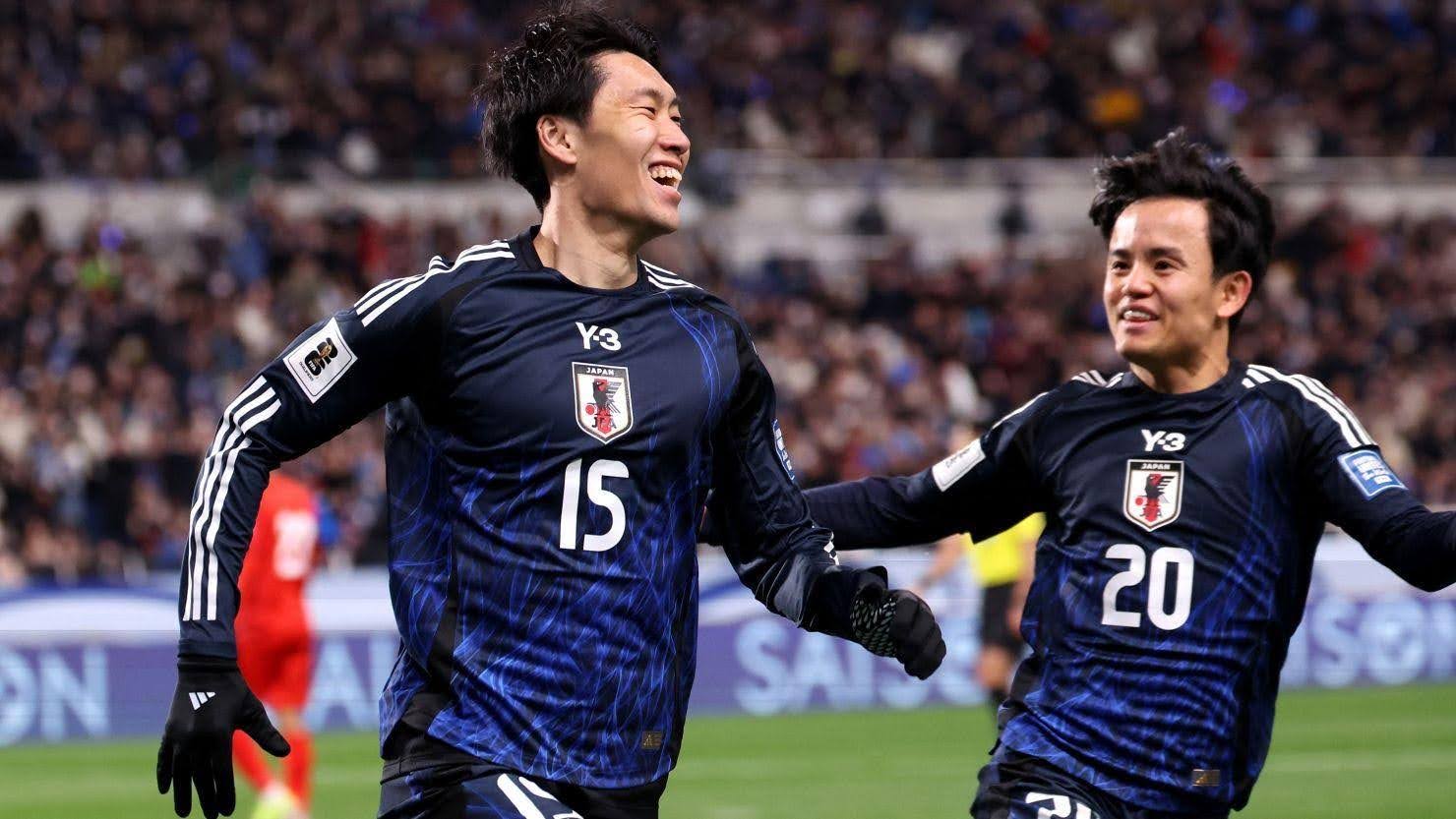
The Japanese national team produced impressive results in their final warm-up match last March. On March 31, Takefusa Kubo and his teammates defeated England (1-0) at Wembley Stadium in London. Japan became the first Asian nation to defeat England at Wembley Stadium but if you doubt about it you can predict them in w88 link. Earlier, on March 28, Japan also defeated host Scotland (1-0) at Hampden Park in Glasgow.
England and Scotland are currently strong European teams. Both are participating in the 2026 World Cup. England even achieved a perfect record, winning all eight of their 2026 World Cup qualifying matches in the European zone. England is also one of the favorites to win the 2026 World Cup.
On October 14, 2025, Japan also defeated Brazil (3-2) in Tokyo in a friendly match. At that time, the Selecao was led by legendary coach Carlo Ancelotti. We know Brazil is one of the favorites to win the 2026 World Cup.
Moriyasu Longest-Ranking
The Japanese national team has seen steady improvement since being taken over by coach Hajime Moriyasu (57) on August 1, 2018. Moriyasu is currently the longest-serving coach in Japanese national team history. His contract expires on July 31, 2026. He successfully led the Samurai Blue to qualify for the round of 16 of the 2022 Qatar World Cup, defeating two world football giants: Germany (2-1) and Spain (2-1) in the group stage. Moriyasu also led Japan to a runner-up finish in the 2019 Asian Cup (losing 3-1 in the final to Qatar).
According to the Japan Football Association (JFA) and Transfermarkt 2026, of the 26 Japanese national team players Moriyasu prepared for the 2026 World Cup, 24 are playing in European leagues (92.3%). With a total market value of Rp 2.51 trillion. The average age of the current Japanese national team players is 26.5 years, with an average height of 180-183 centimeters. The Japanese squad’s fitness level (VO2max) is also world-class, at 65-80 ml/kg/minute.
Captain Takefusa Kubo (24) of Real Sociedad (Spanish La Liga) is also captained. Alongside starting goalkeepers Zion Suzuki (AC Parma/Italian Serie A), Ritsu Doan (Eintracht Frankfurt/German Bundesliga), Daichi Kamada (Crystal Palace/English Premier League), Kaishu Sano (Mainz 05/German Bundesliga), Takumi Minamino (Monaco/French Ligue 1), Kaoru Mitoma (Brighton & Hove Albion/English Premier League), Junya Ito (KRC Genk/Belgian Pro League), Ayase Ueda (Feyenoord/Dutch Eredivisie), and Koki Ogawa (NEC Nijmegen/Eredivisie), Moriyasu has the freedom to play in a modern, balanced formation: 3-4-2-1, 4-3-1-2, or 3-4-1-2.
A balanced formation structure across each line is better maintained, coordinated with fast, tactical, and effective play. At the 2026 World Cup, the Samurai Blue are in Group F, along with the Netherlands, Tunisia, and Sweden.
Japan Makes New History?
The question then is, with their current strength, can Japan make new history at the 2026 World Cup? The answer, of course, isn’t as simple as multiple choice. Football is real-time. It’s determined by current conditions involving many factors.
Japan was indeed fantastic, beating England in a warm-up match at Wembley Stadium, London, two weeks ago. They also crushed the mighty Brazilian team (3-2) in a friendly in Tokyo late last year. However, that doesn’t automatically guarantee that Japan will be able to repeat the feat at the 2026 World Cup.
The World Cup since 1930 has taught us many historical facts. For example, Hungary’s experience as a European powerhouse in the 1950s. Ferenc Puskas and his teammates went undefeated for four years, becoming the strong favorites for the 1954 World Cup in Switzerland. They even crushed West Germany (8-3) in the group stage. However, when they met again in the 1954 World Cup final, Hungary lost to West Germany (2-3).
Another example is Brazil, who were favored for the 1990 World Cup in Italy. Coming in with a 14-match unbeaten streak in two years, Brazil ultimately lost in the round of 16 of the 1990 World Cup (defeated 0-1 by Argentina).
58 Goals in the World Cup
But Japan could make history at the 2026 World Cup. They certainly have the strength to achieve that goal. The Samurai Blue have advanced to the second round (round of 16) of the World Cup four times: 2002, 2010, 2018, and 2022.
In 25 matches across seven consecutive World Cups (1998–2022), Japan recorded 7 wins, 4 draws, and 14 losses. They scored 25 goals and conceded 33 (excluding penalty shootout goals).
To date, South Korea is the only Asian nation to reach the semifinals of the 2002 World Cup. Could Japan match or surpass South Korea’s achievement at the 2026 World Cup? It will be interesting to see.

